←
Back to Blog
AI
•
•
Team PixelPilot
•
4 min read
Vision Transformers in Industry
Prototype vision transformer models, then validate and stress-test them on real industry datasets to surface production
Introduction
Images and videos play an increasingly important role in modern industry. From quality control in factories to security cameras and medical imaging, organizations rely on visual data to make better decisions. To analyze this data efficiently, advanced artificial intelligence models are used. One of the most important recent developments in this area is the Vision Transformer. This technology is changing how industries process and understand visual information.
What Are Vision Transformers?
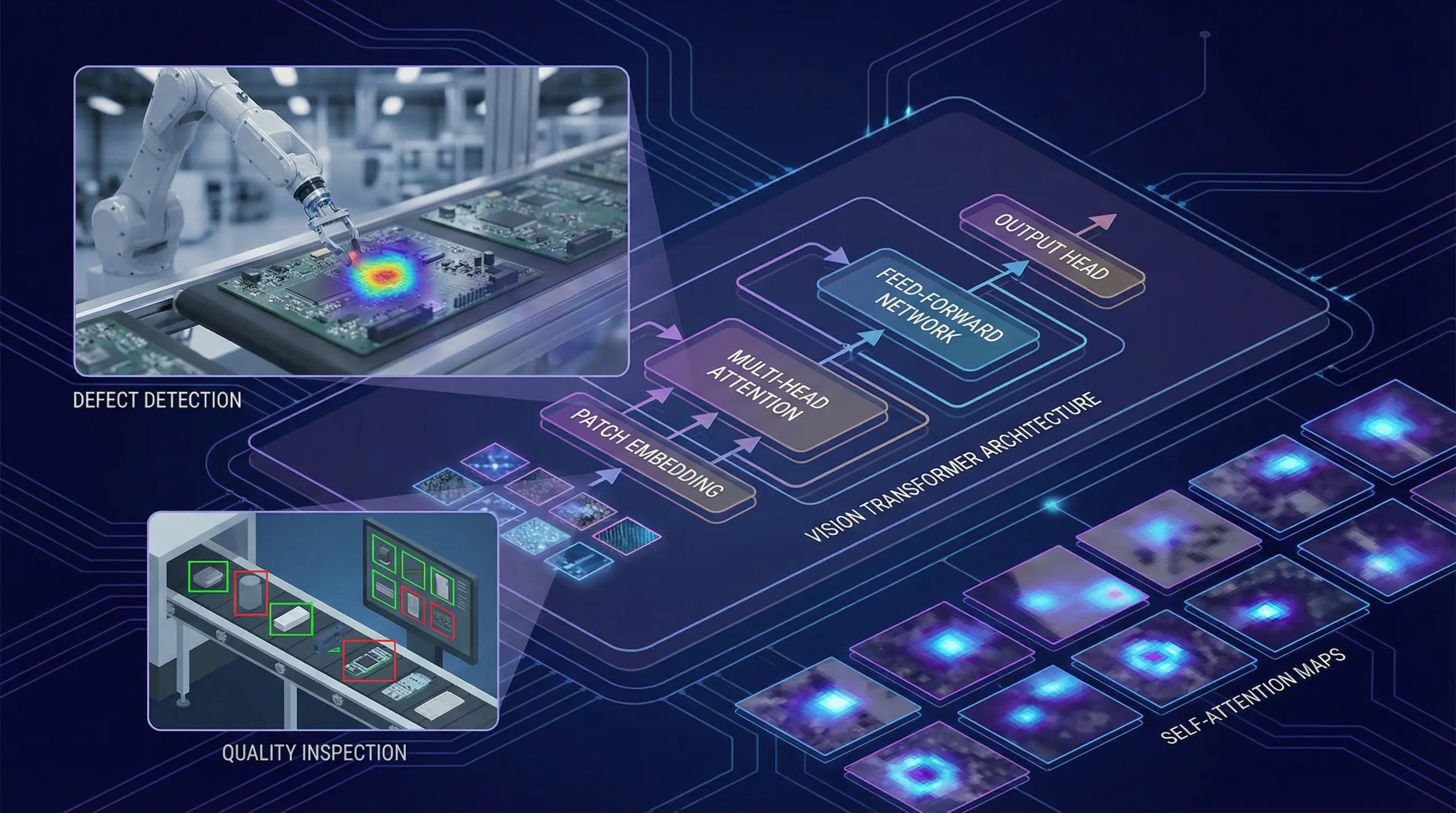
Vision Transformers are a type of artificial intelligence model designed to analyze images. Unlike traditional image-processing methods that focus on small parts of an image at a time, Vision Transformers look at the entire image and understand how different parts relate to each other.
They break an image into small pieces and study the relationships between them, allowing the system to recognize patterns, shapes, and structures more accurately. This approach helps machines see images in a way that is closer to how humans understand visual scenes.
Why Vision Transformers Matter
Traditional image analysis systems often struggle with complex images, lighting changes, or unusual angles. Vision Transformers are better at handling these challenges because they consider the full context of an image.
This leads to higher accuracy and more reliable results, especially in environments where conditions are not always perfect. For industries that depend on precision and safety, this improvement is extremely valuable.
Use in Manufacturing and Quality Control
In manufacturing, Vision Transformers are used to inspect products and detect defects. Cameras capture images of items as they move along production lines. Vision Transformers analyze these images to identify cracks, misalignments, or missing parts.
Because these models understand the overall structure of a product, they can detect problems that traditional systems might miss. This reduces waste, improves product quality, and lowers inspection costs.
Applications in Security and Surveillance
Vision Transformers are also being adopted in security systems. They help analyze video feeds to detect unusual behavior, recognize objects, and monitor restricted areas.
By understanding the full scene instead of isolated details, these systems can reduce false alarms and improve threat detection. This makes security operations more efficient and reliable.
Role in Healthcare and Medical Imaging
In healthcare, Vision Transformers assist in analyzing medical images such as X-rays, scans, and test results. They help identify patterns that may indicate diseases or abnormalities.
Doctors use these tools as decision-support systems, improving diagnosis accuracy while saving time. This technology does not replace medical professionals but enhances their ability to deliver better care.
Impact on Retail and Customer Experience
Retailers use Vision Transformers to analyze customer behavior in stores, manage inventory, and improve layout design. Visual data helps understand how customers interact with products and spaces.
These insights allow businesses to improve shopping experiences, reduce theft, and optimize store operations without relying solely on manual observation.
Business Benefits and Competitive Advantage
Vision Transformers offer several business advantages. They improve accuracy, reduce manual work, and enable faster decision-making. By automating complex visual tasks, organizations can focus on higher-value activities.
Companies that adopt this technology gain a competitive edge by operating more efficiently and responding quickly to market demands.
Challenges and Considerations
Despite their benefits, Vision Transformers require significant computing resources and high-quality data. Implementing them involves careful planning, skilled teams, and responsible data handling.
Organizations must also consider ethical and privacy issues, especially when using visual data involving people. Clear policies and transparency are essential.
Future Outlook
Vision Transformers continue to evolve, becoming more efficient and easier to deploy. As technology advances, their adoption across industries is expected to grow rapidly.
They will play a key role in shaping the future of automation, safety, and intelligent decision-making across many sectors.
Conclusion
Vision Transformers represent a major step forward in visual artificial intelligence. By enabling machines to understand images more accurately and holistically, they unlock new possibilities across industries.
As organizations seek smarter, faster, and more reliable ways to work with visual data, Vision Transformers are becoming an essential tool in modern industrial innovation.
Need help with your digital project?
Our team builds websites, mobile apps, e-commerce platforms and runs data-driven marketing campaigns for businesses across the UK.