←
Back to Blog
AI
•
•
Team PixelPilot
•
5 min read
NLP in Practice: Search and Support
Apply NLP to lift search and support: sharpen intent models, tune response scoring, and boost relevance and resolution r
Introduction
Natural Language Processing, or NLP, is a branch of artificial intelligence that enables machines to understand, interpret, and generate human language. It has become a critical tool for businesses that want to improve search functionality, customer support, and overall user experience. By leveraging NLP, organizations can make information more accessible, automate repetitive tasks, and provide personalized support at scale.
NLP is now widely used in search engines, chatbots, virtual assistants, and knowledge management systems. Applying NLP effectively requires understanding the data, the business problem, and the user experience, as well as implementing models that balance accuracy, performance, and fairness.
NLP in Search
Search functionality is a core component of many digital products, from e-commerce websites to knowledge bases. Traditional keyword-based search often fails to understand user intent, leading to irrelevant or incomplete results. NLP enhances search in several ways:
Semantic Search
Semantic search focuses on understanding the meaning behind a query rather than matching exact keywords. For example, a user searching for “best lightweight running shoes” should receive relevant results even if the product descriptions do not contain the exact phrase. NLP techniques like word embeddings and transformer models enable semantic search by capturing context and relationships between words.
Query Understanding
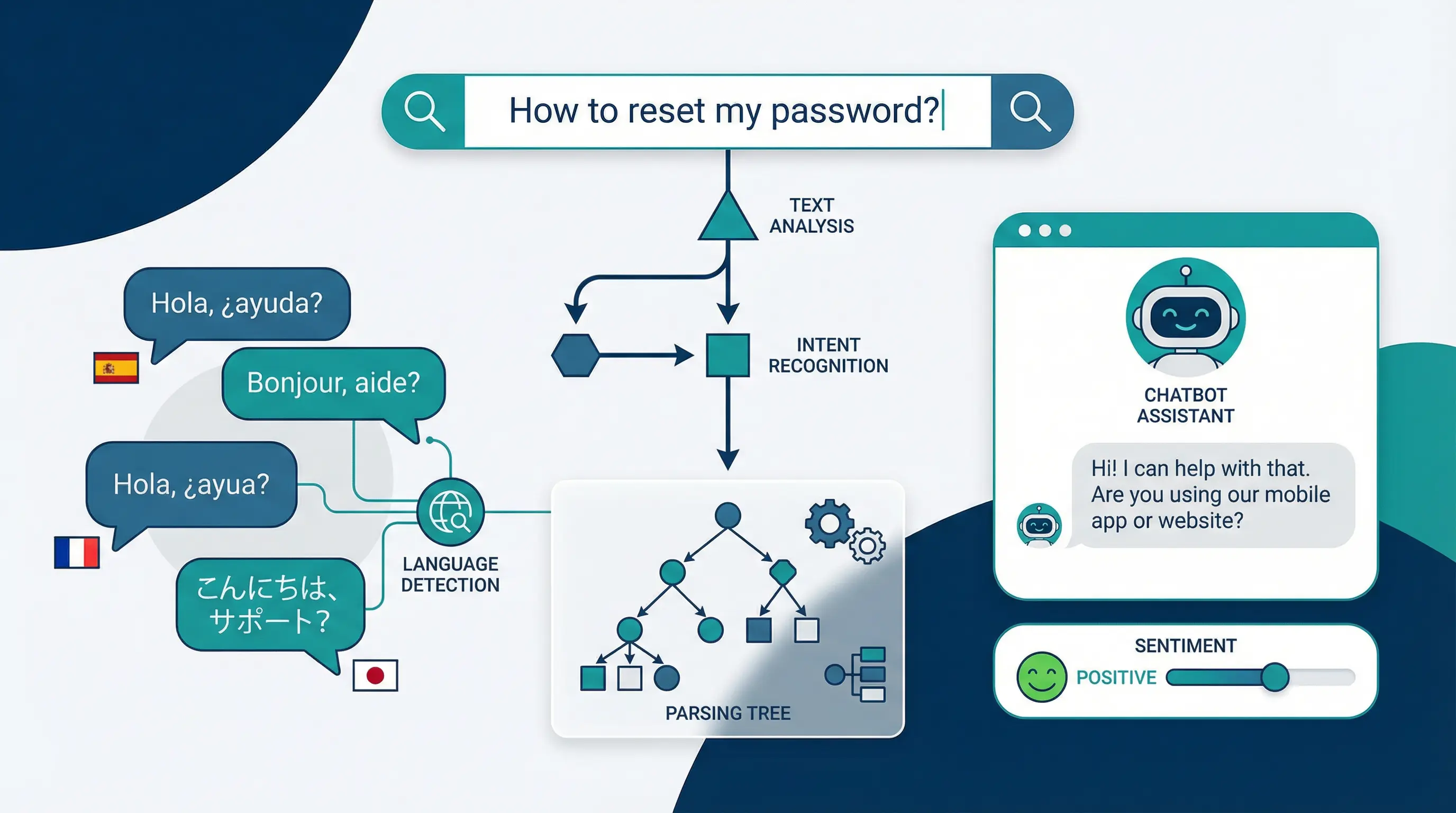
NLP improves query understanding by handling variations in spelling, grammar, and phrasing. It can also detect synonyms, abbreviations, and even multi-language queries. Techniques such as tokenization, lemmatization, and named entity recognition help the system interpret user intent accurately.
Ranking and Relevance
Once relevant results are retrieved, NLP models can rank them based on contextual relevance. This involves analyzing the content of documents or products, identifying key topics, and comparing them to the user query. Machine learning models trained on historical click-through and engagement data further refine ranking, improving user satisfaction.
Examples in Practice
E-commerce: Suggesting products even if the query differs from product descriptions
Enterprise search: Locating internal documents based on meaning rather than exact wording
Digital assistants: Providing context-aware results in response to natural queries
NLP in Customer Support
Customer support is another area where NLP delivers significant value. Organizations can leverage NLP to automate routine inquiries, provide instant responses, and improve overall service quality.
Chatbots and Virtual Assistants
Chatbots use NLP to interpret user queries and provide relevant answers or perform actions. Modern virtual assistants understand context, follow conversational flow, and escalate complex issues to human agents when necessary.
Sentiment Analysis
Sentiment analysis allows organizations to understand the tone of customer messages. By detecting frustration, satisfaction, or urgency, NLP can prioritize support tickets, flag critical issues, and improve customer experience.
Knowledge Base Search
NLP enhances knowledge base search by mapping user questions to relevant articles, FAQs, or troubleshooting guides. It reduces the need for human intervention and ensures consistent, accurate responses.
Automation and Efficiency
Automated NLP-driven support reduces response times, lowers operational costs, and allows support teams to focus on complex, high-value tasks. Combining NLP with workflow automation can also trigger follow-up actions, schedule appointments, or update records automatically.
Technical Considerations
Implementing NLP in search and support involves several technical challenges:
Data quality: NLP models require clean, structured, and representative datasets to perform well
Model selection: Transformers like BERT, GPT, or specialized embeddings improve understanding but may require significant computational resources
Real-time performance: Search and support applications often need near-instant responses
Bias and fairness: Models must be monitored to prevent biased or inappropriate responses
Multilingual support: Global applications need models capable of understanding multiple languages and dialects
Best Practices
Preprocess text by cleaning, normalizing, and tokenizing
Fine-tune models on domain-specific data for improved relevance
Combine rule-based logic with machine learning for hybrid approaches
Continuously evaluate model performance using metrics such as precision, recall, and user satisfaction
Monitor production systems to detect drift, errors, or emerging biases
Business Benefits
Applying NLP in search and support yields significant advantages:
Improved user experience: Faster, more accurate search and support increases satisfaction
Reduced operational costs: Automation decreases reliance on human agents for routine tasks
Increased engagement: Context-aware search and personalized responses boost retention and conversions
Data-driven insights: Analysis of queries and interactions provides actionable business intelligence
Challenges and Limitations
Handling ambiguous queries remains difficult
Resource-intensive models may increase infrastructure costs
Continuous maintenance is required to keep knowledge bases and models up to date
Ethical considerations around privacy, data collection, and fairness must be addressed
Conclusion
NLP in practice transforms search and customer support by enabling machines to understand and act on human language. From semantic search to intelligent chatbots, NLP enhances accessibility, efficiency, and engagement across digital platforms.
Organizations that implement NLP thoughtfully can deliver faster, more relevant, and personalized experiences while gaining actionable insights from user interactions. As NLP technologies continue to advance, their impact on business operations and customer satisfaction will only grow.
I can also create a visual workflow diagram showing how NLP processes a query in search and support systems—from input to intent detection, semantic matching, response generation, and ranking—making it easier for teams to understand implementation.
Need help with your digital project?
Our team builds websites, mobile apps, e-commerce platforms and runs data-driven marketing campaigns for businesses across the UK.