←
Back to Blog
Emerging Tech
•
•
Team PixelPilot
•
4 min read
Gartner Hype Cycle: What Matters
Cut through the Gartner Hype Cycle clutter to find real signals, then prioritize 30–90‑day pilots that deliver fast, mea
Introduction
The Gartner Hype Cycle is a widely used framework for understanding how new technologies progress — from early excitement to mainstream adoption. With technology evolving faster than ever, organizations need a straightforward way to assess value, risk, and realistic timelines for adoption.
Using the Hype Cycle helps leaders decide where to invest, which pilots to run, and when to scale — while avoiding shiny trends that won’t deliver near-term value.
The Stages of the Hype Cycle
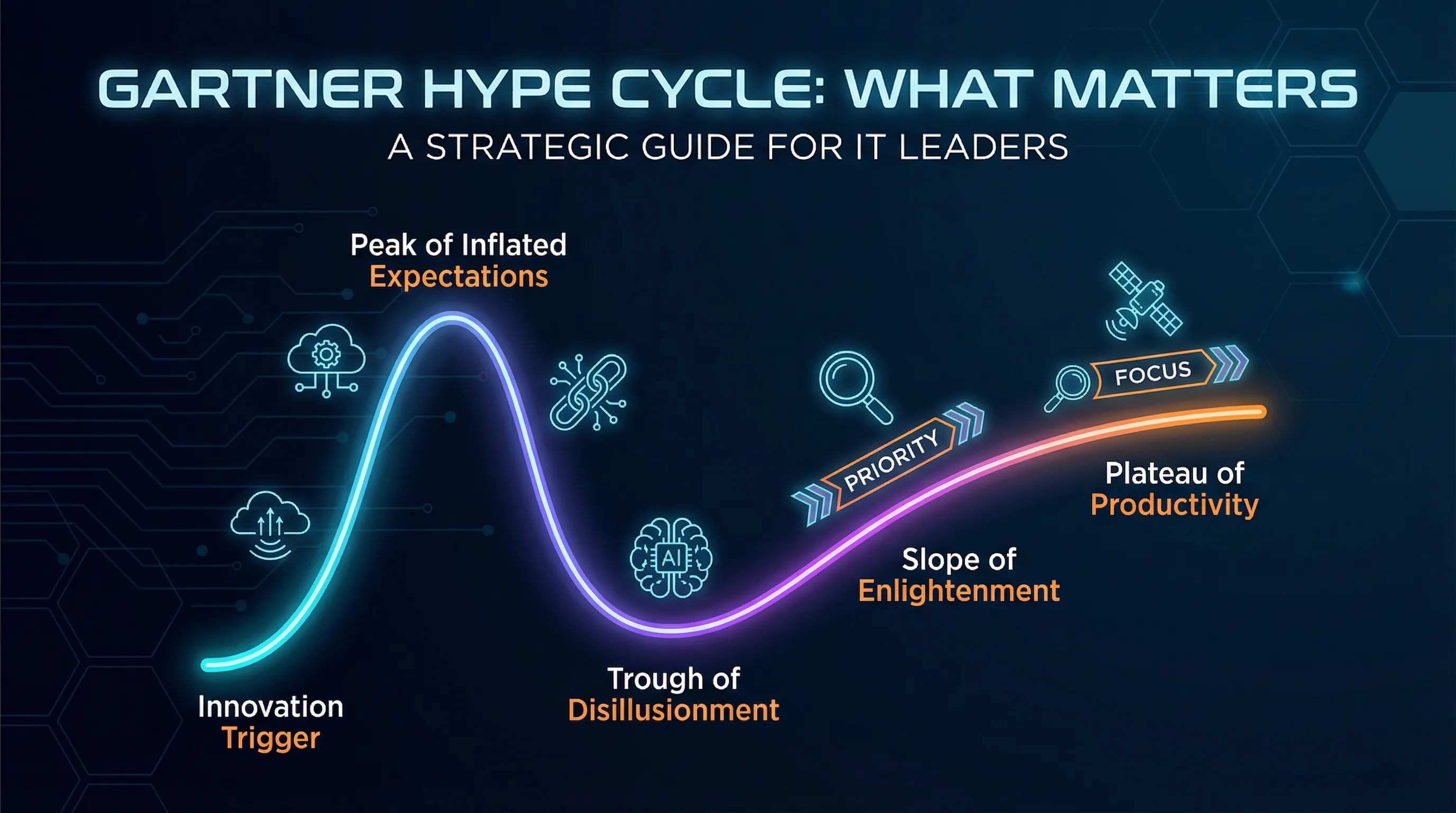
The Gartner Hype Cycle is organized into five stages that map a technology’s lifecycle:
1. Innovation Trigger
A breakthrough, major announcement, or emerging idea creates buzz
Early prototypes and proof-of-concept work start to appear
Practical adoption is rare; uncertainty is high
Example: Quantum computing, early-stage AI frameworks
2. Peak of Inflated Expectations
Media and market hype reach a high point
Expectations often outpace what the technology can realistically deliver today
Some early adopters succeed, but many projects fall short
Example: Blockchain applications beyond cryptocurrency
3. Trough of Disillusionment
Reality bites; limitations and failures become visible
Interest dips, and some vendors pivot or leave the market
Only organizations with clear, aligned use cases keep investing
Example: Certain AR/VR enterprise projects after the initial splash
4. Slope of Enlightenment
Practical, repeatable uses start to emerge
More organizations adopt successfully as benefits become clearer
Vendors refine products based on real-world feedback
Example: Cloud adoption in regulated industries
5. Plateau of Productivity
The technology becomes mainstream
Benefits are measurable and widely recognized
Standards, best practices, and predictable ROI are established
Example: SaaS solutions and mature AI tools in production
Why the Hype Cycle Matters
Managing Expectations
Don’t invest just because a technology is popular
Set realistic timelines for ROI and adoption
Prepare teams for the bumps that come with early phases
Prioritizing Innovation
Spot technologies with lasting strategic potential rather than fleeting hype
Target pilots and experiments where the business case is clear
Risk Management
Identify technical, operational, and financial risks tied to adoption
Plan fallback options and contingencies before scaling
Strategic Timing
Different organizations should adopt at different stages:
Early adopters can win advantage by moving during the Peak of Inflated Expectations
More conservative organizations reduce risk by waiting for the Slope of Enlightenment or Plateau of Productivity
Practical Use of the Hype Cycle
Evaluate Use Cases
Decide whether a technology actually solves a business problem
Align any adoption with strategy, resources, and operational capacity
Pilot Programs
Run small, time-boxed pilots to validate ideas before broad rollout
Track KPIs, costs, and adoption hurdles closely
Vendor Assessment
Check vendor maturity, customer success stories, and product roadmaps
Favor vendors moving toward the Slope of Enlightenment
Continuous Monitoring
Watch how technologies shift on the Hype Cycle over time
Update investment decisions and timelines as the landscape changes
Business Benefits
Organizations that use the Hype Cycle well get:
Lower risk by steering clear of purely hyped technologies
Better ROI by focusing on proven or strategically aligned innovations
Competitive advantage from spotting and adopting transformative tech early
More grounded strategic planning that balances innovation with operational stability
Common Pitfalls
Chasing hype: Backing technologies only because they’re trending
Ignoring context: Assuming every technology follows the same path
Premature scaling: Expanding too quickly during the Trough of Disillusionment
Failure to reassess: Not updating strategy as technologies progress along the cycle
Conclusion
The Gartner Hype Cycle is a practical tool for technology strategy — helping organizations tell hype apart from realistic potential. By understanding each stage, teams can prioritize investments, set proper expectations, and adopt emerging technologies more confidently.
Organizations that fold the Hype Cycle into decision-making gain a repeatable approach to innovation, enabling them to capture transformative value while keeping risk in check.
Need help with your digital project?
Our team builds websites, mobile apps, e-commerce platforms and runs data-driven marketing campaigns for businesses across the UK.