←
Back to Blog
AI
•
•
Team PixelPilot
•
4 min read
Feature Stores and Governance
Bring feature artifacts together, enforce access and usage rules, and record lineage so teams deliver consistent, govern
Introduction
In modern machine learning (ML) workflows, data is the foundation of every model. Ensuring reliable, consistent, and well-governed features—the individual variables used in models—is critical for successful ML deployment.
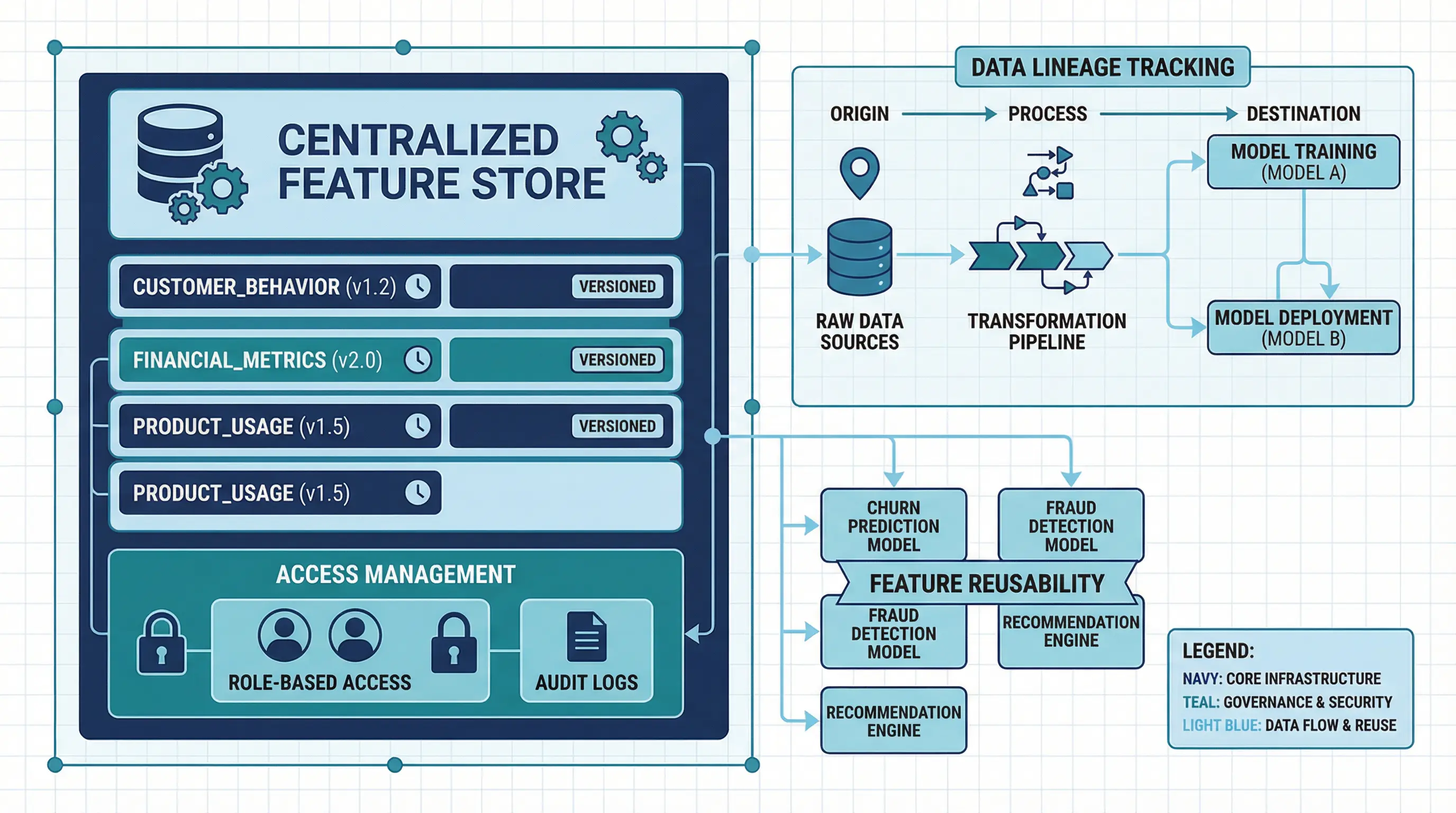
Feature stores provide a centralized system for storing, managing, and serving features, while feature governance ensures that these features are accurate, compliant, and reusable. Together, they increase model reliability, accelerate development, and maintain regulatory compliance across the ML lifecycle.
Understanding Feature Stores
What is a Feature Store?
A feature store is a centralized platform for:
Storing historical and real-time features used in ML models
Serving consistent features for training and inference
Enabling reuse across different ML models and teams
Think of it as a data warehouse specifically optimized for ML features, ensuring that the same feature values are used in both model training and production.
Core Components
Feature Registry – Catalog of available features with metadata
Feature Storage – Historical feature values for training models
Feature Serving Layer – Real-time access for model inference
Monitoring and Governance Tools – Ensures quality, compliance, and consistency
Benefits of Feature Stores
Consistency and Accuracy
Prevents discrepancies between training and inference, known as “training-serving skew”
Ensures features are calculated using the same logic across teams and models
Reusability and Collaboration
Teams can share features rather than recreating them
Reduces duplication, accelerates model development, and promotes best practices
Real-Time ML Support
Provides low-latency feature access for online predictions
Enables applications like personalized recommendations, fraud detection, or dynamic pricing
Compliance and Traceability
Tracks data lineage, ownership, and transformations
Supports regulatory requirements for privacy, explainability, and auditability
Feature Governance: Why It Matters
Feature governance ensures that ML features are trustworthy, documented, and compliant throughout their lifecycle.
Key Principles
Data Quality Management
Monitor for missing values, outliers, and drift
Implement automated checks for feature integrity
Access Control and Security
Define roles for feature creation, approval, and usage
Ensure sensitive features are protected and compliant with regulations (e.g., GDPR, HIPAA)
Documentation and Metadata
Maintain clear definitions, units, and transformation logic
Enable teams to understand feature context and provenance
Lifecycle Management
Retire outdated or deprecated features
Track versions for reproducibility in model retraining
Implementing a Feature Store
Step 1: Identify Features
Audit existing ML pipelines to determine commonly used features
Prioritize features based on reuse potential and business impact
Step 2: Define Storage and Access
Decide between historical storage (for model training) and real-time serving (for inference)
Choose storage solutions optimized for low-latency access
Step 3: Automate Feature Pipelines
Use ETL/ELT pipelines to compute, validate, and store features
Ensure features are updated consistently with new data
Step 4: Implement Governance
Track ownership, lineage, and transformations
Establish automated quality checks and alerting systems
Apply access policies for sensitive features
Step 5: Monitor and Evolve
Continuously monitor feature usage, performance, and drift
Remove unused features to maintain a clean and maintainable store
Real-World Use Cases
Retail and E-commerce
Customer segmentation features for personalized recommendations
Product popularity and inventory features for dynamic pricing
Finance and Banking
Transaction history and risk indicators for fraud detection
Credit scoring features that comply with regulatory audits
Healthcare
Patient metrics and treatment history for predictive modeling
Ensures compliance with HIPAA while enabling AI-driven insights
Challenges and Considerations
Complexity: Implementing a feature store requires integration with multiple data sources and pipelines
Consistency: Ensuring identical feature calculations across batch and real-time systems can be challenging
Governance Overhead: Maintaining lineage, documentation, and access control requires process discipline
Cultural Adoption: Teams must shift from ad-hoc feature creation to standardized, reusable practices
Business Benefits
Adopting feature stores with strong governance leads to:
Faster ML development due to reusable, pre-validated features
Higher model accuracy by reducing training-serving skew
Regulatory compliance through tracked data lineage and access controls
Cost savings by reducing duplicate feature engineering efforts
Conclusion
Feature stores and governance are critical enablers for modern machine learning at scale. By centralizing features, ensuring consistency, and maintaining strict governance, organizations can accelerate ML projects, improve model reliability, and comply with regulatory requirements.
A well-implemented feature store is not just a technical tool—it’s a strategic asset that improves collaboration, efficiency, and trust in AI-driven decision-making.
Need help with your digital project?
Our team builds websites, mobile apps, e-commerce platforms and runs data-driven marketing campaigns for businesses across the UK.