←
Back to Blog
AI
•
•
Team PixelPilot
•
4 min read
Document Intelligence for Ops
Capture structured data from PDFs, forms, and emails, then trigger automated workflows to remove manual handoffs and spe
Introduction
Operations teams deal with vast amounts of documents daily—contracts, invoices, reports, emails, and compliance records. Traditional document management is often manual, error-prone, and time-consuming, leading to inefficiencies and operational risks.
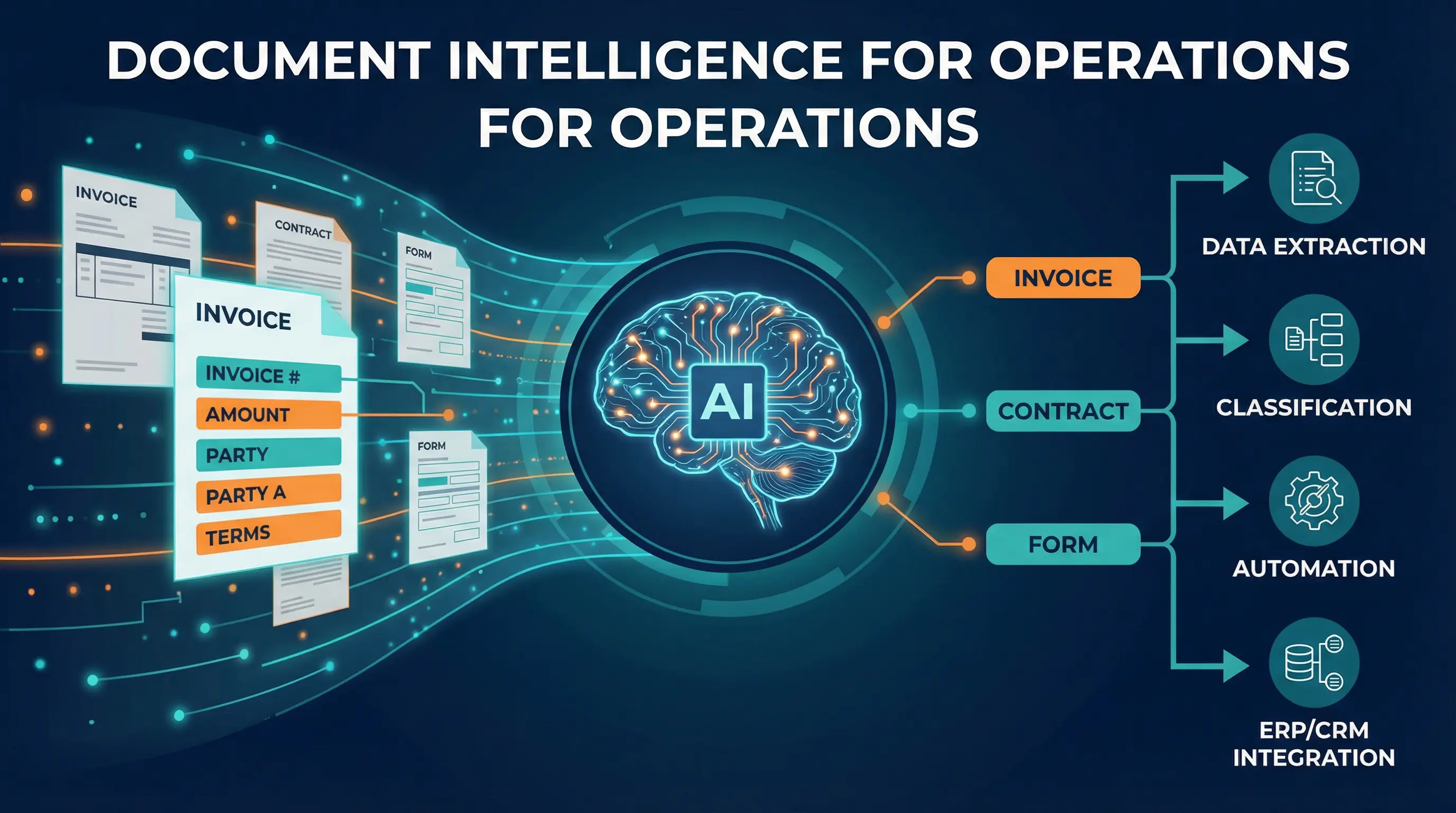
Document intelligence uses AI, natural language processing (NLP), and machine learning (ML) to extract, analyze, and act on information from unstructured and structured documents. By implementing document intelligence, organizations can automate workflows, reduce errors, and make data-driven operational decisions.
What is Document Intelligence
Document intelligence combines several technologies:
Optical Character Recognition (OCR) – Converts scanned documents and images into machine-readable text
Natural Language Processing (NLP) – Understands and interprets text to extract meaning, entities, and context
Machine Learning – Classifies documents, detects patterns, and predicts outcomes based on historical data
Integration with Operational Systems – Connects insights from documents to ERP, CRM, and workflow tools
The result is an intelligent system that can read, understand, and act on documents, enabling faster decision-making and reducing reliance on manual labor.
Key Applications for Operations
1. Invoice and Payment Processing
Automatically extract invoice details like vendor, amount, date, and line items
Validate invoices against purchase orders and contracts
Reduce manual entry errors and accelerate approval workflows
2. Contract Analysis and Compliance
Identify key clauses, obligations, and renewal dates
Flag risks such as non-compliance, missing signatures, or expiration
Support legal and compliance teams with faster review cycles
3. Customer Service and Support
Extract structured data from emails, support tickets, or forms
Route documents automatically to the appropriate team or system
Reduce response times and improve service quality
4. Regulatory Reporting
Automatically extract relevant metrics from operational documents
Generate reports for auditors and regulators with minimal manual intervention
Ensure consistency and accuracy in compliance reporting
5. Knowledge Management
Organize large document repositories by topics, entities, or use cases
Enable semantic search, so teams can find relevant information quickly
Reduce time spent searching for critical operational information
Implementing Document Intelligence
Step 1: Document Ingestion
Collect structured and unstructured documents from email, file shares, ERP, or cloud storage
Standardize formats for consistency
Step 2: Preprocessing
Apply OCR for scanned documents
Clean and normalize text (remove unnecessary formatting or artifacts)
Detect document type for classification
Step 3: Information Extraction
Use NLP models to identify entities, dates, monetary values, and key clauses
Tag metadata for search, compliance, and workflow automation
Step 4: Integration and Action
Feed structured data into operational systems for automation, alerts, and reporting
Trigger workflows such as approvals, renewals, or escalation based on document content
Step 5: Monitoring and Optimization
Track extraction accuracy, errors, and processing time
Continuously retrain models with new documents to improve performance
Implement feedback loops from operations teams for real-world corrections
Best Practices
Start with high-value documents – Focus on invoices, contracts, or compliance documents first
Combine automation with human oversight – Human-in-the-loop ensures quality and builds trust
Maintain data security and compliance – Encrypt documents, control access, and audit data usage
Leverage scalable cloud solutions – Ensure document intelligence can handle growing operational volumes
Measure ROI – Track time savings, error reduction, and operational efficiency improvements
Business Benefits
Faster operations: Reduced manual processing leads to quicker approvals and decisions
Lower operational costs: Automation minimizes repetitive tasks and reduces errors
Improved compliance: Automated extraction ensures accuracy and traceability for audits
Better decision-making: Actionable insights from documents inform strategic and operational choices
Enhanced scalability: Teams can handle higher volumes of documents without additional headcount
Challenges and Considerations
Data quality: Poorly scanned or formatted documents can reduce extraction accuracy
Integration complexity: Connecting document intelligence to legacy ERP or CRM systems requires planning
Change management: Teams must adopt new processes and trust AI-generated outputs
Domain-specific models: Generic NLP may not capture industry-specific terminology, requiring fine-tuning
Conclusion
Document intelligence transforms operational workflows by turning unstructured documents into actionable data. By leveraging OCR, NLP, and machine learning, operations teams can automate tedious tasks, reduce errors, and improve decision-making.
Organizations that implement document intelligence effectively gain faster, more accurate, and scalable operations, positioning themselves to handle growing document volumes while supporting compliance, efficiency, and strategic goals.
Need help with your digital project?
Our team builds websites, mobile apps, e-commerce platforms and runs data-driven marketing campaigns for businesses across the UK.