←
Back to Blog
Web design
•
•
Team PixelPilot
•
4 min read
Conversions with Clean Information Architecture
Strip back your information architecture into a clean, intuitive structure that nudges users toward conversions, then va
Introduction
A website or app can have great design and content, but if users cannot find what they need quickly, conversions suffer. Information Architecture (IA) is the practice of organizing, structuring, and labeling content to make it easy to navigate and understand.
Clean IA directly impacts conversion rates, user satisfaction, and business outcomes by guiding visitors toward desired actions with minimal friction.
Understanding Information Architecture
What is Information Architecture?
Definition: The organization and labeling of content, features, and navigation within a digital product
Focuses on user goals, logical hierarchies, and discoverability
Ensures that both humans and machines (like search engines) understand the site’s structure
Key Components
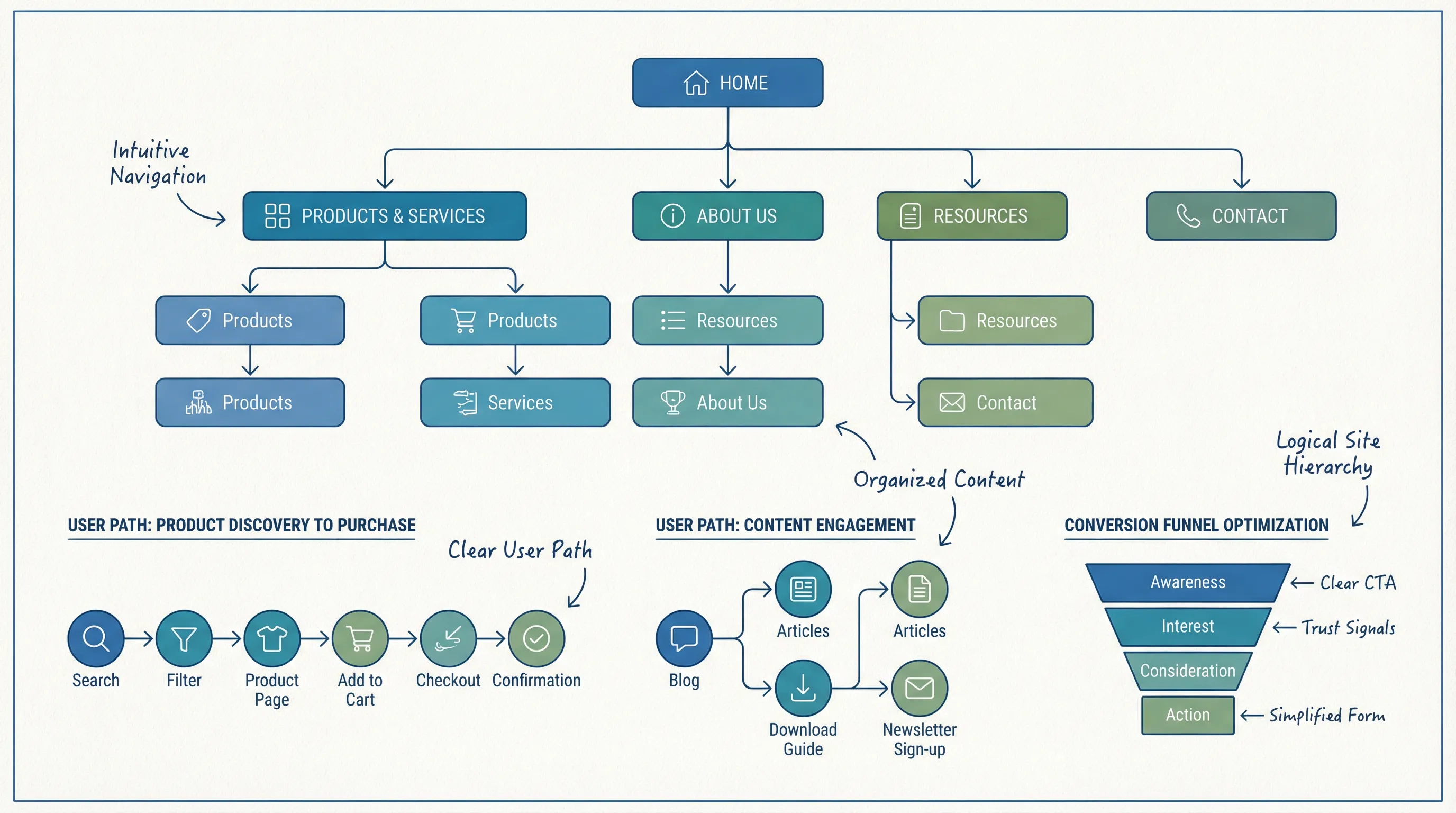
Hierarchy and Navigation – Clear menus, breadcrumbs, and categories
Content Grouping – Logical clusters of related pages or features
Labels and Terminology – Consistent, intuitive naming for links, buttons, and headings
Search and Filters – Tools to help users quickly locate content
How IA Affects Conversions
Reducing Cognitive Load
Users make faster decisions when information is logically structured
Minimizes confusion and prevents abandonment during critical tasks like checkout or signup
Improving Findability
Clean IA ensures important content is easy to find
Visitors can locate products, services, or information without frustration, increasing the likelihood of conversion
Guiding User Journeys
Thoughtful IA helps guide users along paths toward key actions
Strategically placing CTAs (calls to action) within the structure improves completion rates
Supporting SEO
Clear hierarchies and labeling improve search engine crawlability
Enhances organic traffic, indirectly boosting conversions
Principles for Clean Information Architecture
1. Start with User Research
Identify user goals, behaviors, and pain points
Map user journeys to understand how visitors navigate content
2. Create a Logical Hierarchy
Group similar content together
Use top-level categories for broad topics and subcategories for details
Avoid overly deep structures that frustrate users
3. Use Consistent Labels and Terminology
Use plain language that matches user expectations
Avoid jargon, ambiguous terms, or inconsistent naming
4. Prioritize Content
Highlight the most important content, features, or offers
Use visual hierarchy and IA to guide attention toward conversion points
5. Optimize Navigation
Use clear menus, filters, and breadcrumbs
Include a search function for faster discovery
Reduce clicks required to reach key pages
Implementing IA for Better Conversions
Step 1: Audit Existing Structure
Identify redundant, outdated, or hard-to-find content
Map current user journeys and conversion bottlenecks
Step 2: Plan and Prototype
Create sitemaps, wireframes, or flow diagrams
Test different hierarchies and labeling schemes with real users
Step 3: Test for Usability
Conduct usability tests, A/B tests, and tree testing to validate IA decisions
Collect feedback on ease of navigation and clarity
Step 4: Iterate and Improve
Continuously refine IA based on analytics, user feedback, and business goals
Monitor key metrics: conversion rates, bounce rates, and search behavior
Best Practices
Keep it simple – Avoid overcomplicating categories and submenus
Use predictive paths – Anticipate what users want and provide direct access
Balance content depth and breadth – Ensure users can navigate without getting lost
Integrate search and filtering – Supports users who prefer self-directed discovery
Document IA guidelines – Maintain consistency across new pages, features, and updates
Business Benefits
Higher conversion rates due to reduced friction and improved findability
Better user engagement from intuitive navigation and organized content
Stronger SEO performance with improved crawlability and indexation
Reduced support burden as users find information independently
Scalable growth by providing a structured framework for new content
Challenges and Considerations
Large or complex websites may require multiple IA iterations
Dynamic content and frequent updates can disrupt hierarchy
Balancing user needs with business goals requires careful planning
Cross-team collaboration is essential between UX, content, SEO, and marketing teams
Conclusion
Clean information architecture is critical for driving conversions. By organizing content logically, labeling consistently, and designing intuitive navigation, teams can reduce friction, guide users toward desired actions, and maximize business outcomes.
Investing in IA is not just a design choice—it is a strategic approach to improving usability, boosting engagement, and increasing revenue. A well-structured digital product ensures that users find what they need quickly, leading to higher satisfaction, loyalty, and conversion rates.
Need help with your digital project?
Our team builds websites, mobile apps, e-commerce platforms and runs data-driven marketing campaigns for businesses across the UK.