←
Back to Blog
AI
•
•
Team PixelPilot
•
5 min read
A/B Testing with AI Features
Plan A/B experiments for AI features: choose causal metrics, control rollouts, and quantify treatment lift with clear, m
Introduction
A/B testing is a fundamental method for optimizing digital products and marketing strategies, allowing teams to compare two versions of a webpage, app feature, or campaign element to determine which performs better.
In 2026, as AI features become increasingly integrated into applications—such as recommendation engines, chatbots, predictive analytics, and personalization algorithms—traditional A/B testing alone may not be sufficient. AI introduces dynamic, data-driven behaviors that require advanced experimentation strategies to measure impact effectively.
This article explores how to conduct A/B testing when AI features are involved, best practices, challenges, and practical guidance for actionable results.
Understanding AI Features in A/B Testing
What Makes AI Features Different
AI-driven features differ from static elements in several ways:
Dynamic Outputs – AI features generate personalized content or predictions that change per user
Continuous Learning – Some AI systems adapt over time, meaning results may evolve during the experiment
Complex Metrics – Success may involve multiple outcomes, such as engagement, revenue, or retention
Interdependencies – AI predictions may interact with other features or user behaviors, making isolation challenging
Implications for A/B Testing
Traditional A/B frameworks assume fixed behavior, whereas AI requires careful design to avoid confounding factors
Testing must account for personalization, model drift, and interaction effects
Designing A/B Tests for AI Features
1. Define Clear Objectives
Establish measurable goals specific to the AI feature:
Increased click-through rates (CTR) for recommendations
Improved conversion from AI-powered forms or chatbots
Higher engagement or session duration with AI content personalization
2. Choose the Right Experiment Type
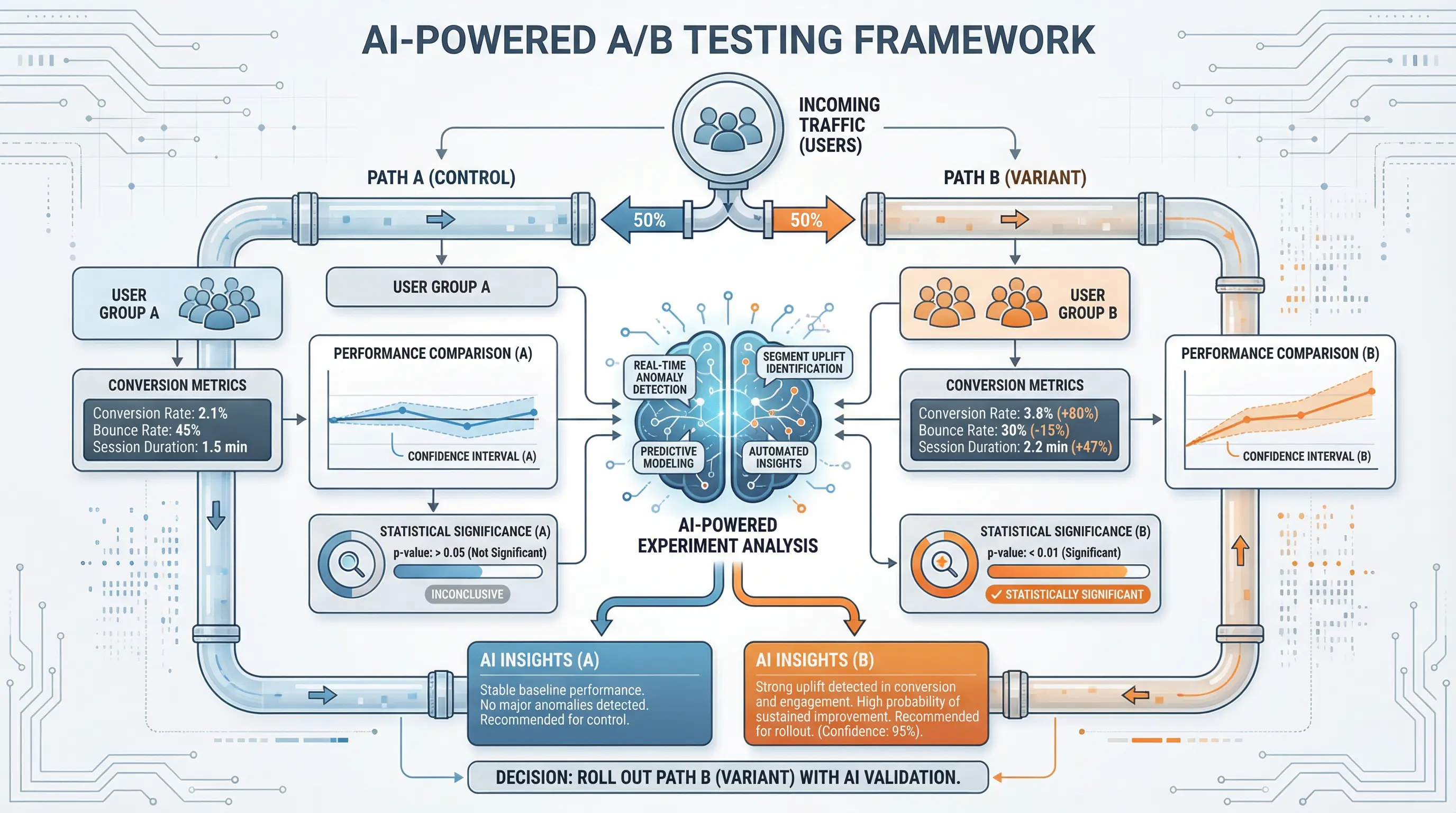
Classic A/B Test – Compare two groups: AI-enabled vs. control
Multi-Armed Bandit – Dynamically allocates traffic to better-performing variants, suitable for adaptive AI models
Personalized or Segment-Based Tests – Evaluate AI performance for different user segments separately
3. Randomization and Isolation
Randomly assign users to control and AI test groups
Ensure consistent AI exposure for each user to avoid data contamination
Consider stratified sampling for heterogeneous audiences
4. Duration and Sample Size
AI features may require larger sample sizes due to variability in output
Ensure the test runs long enough to capture meaningful user interactions and behaviors
Monitor model drift over time to ensure results reflect true AI performance
Metrics and Measurement
Choosing the Right Metrics
Primary Metrics – Core business outcomes such as revenue, conversion, or retention
Secondary Metrics – Engagement, session length, or feature adoption
AI-Specific Metrics – Prediction accuracy, recommendation click-through, or model confidence scores
Considerations for Analysis
Use statistical significance and confidence intervals to validate results
Apply multi-metric evaluation to capture holistic impact
Monitor distributional effects across segments, as AI may improve outcomes for some users while having neutral or negative effects for others
Best Practices for A/B Testing AI Features
1. Test Early and Iteratively
Start with small-scale experiments to validate assumptions and model behavior
Iterate on AI model parameters or training data to improve performance
2. Use Shadow Mode Testing
Run AI features in shadow mode alongside control, without impacting user experience
Compare predicted outcomes with actual outcomes to measure impact before full deployment
3. Combine Experimentation and Analytics
Integrate AI performance logs with A/B test results
Use insights to refine both the model and user experience
4. Avoid Bias in Testing
Ensure randomization is fair and represents all user groups
Avoid exposing the AI model to only certain demographics, which could skew results
5. Document Everything
Record model versions, parameters, datasets, and test setup
Maintain clear documentation for reproducibility and auditability
Challenges and Considerations
Model Drift – AI models may adapt during testing, complicating interpretation
Interdependent Features – AI outputs may influence user behavior in multiple ways, making attribution tricky
Data Privacy – Ensure testing complies with GDPR, CCPA, and other regulations
Complex Metrics – Some AI features require multiple layers of measurement to evaluate effectively
Infrastructure Needs – Real-time AI experimentation may require advanced analytics and logging systems
Real-World Use Cases
E-Commerce Recommendations – Test AI-powered product recommendations vs. manual or rule-based suggestions
Chatbots and Conversational AI – Evaluate AI-assisted support against standard scripted interactions
Content Personalization – Compare personalized news feeds or marketing emails to generic versions
Pricing and Offers – Experiment with AI-driven dynamic pricing vs. static pricing
Fraud Detection – Test AI models for anomaly detection in payments, monitoring false positives and user impact
Business Benefits
Data-Driven Decision Making – Quantifies the real-world impact of AI features
Optimized AI Performance – Iterative testing refines models for better results
Higher Conversion and Engagement – Identifies which AI outputs truly resonate with users
Risk Mitigation – Detects negative user impacts before wide deployment
Scalable Experimentation – Enables organizations to deploy AI features safely and confidently
Conclusion
A/B testing with AI features requires careful planning, robust metrics, and adaptive methodologies. Unlike static features, AI introduces dynamic behavior, personalization, and learning, which must be considered when designing experiments.
By combining clear objectives, proper randomization, shadow mode testing, iterative refinement, and comprehensive measurement, organizations can maximize the impact of AI-driven features while minimizing risks.
AI-enabled A/B testing not only validates performance but also accelerates innovation, ensuring that digital products deliver tangible business value and superior user experiences in a data-driven world.
Need help with your digital project?
Our team builds websites, mobile apps, e-commerce platforms and runs data-driven marketing campaigns for businesses across the UK.